The Hidden Cost of Duplicating State in Real-Time Architectures
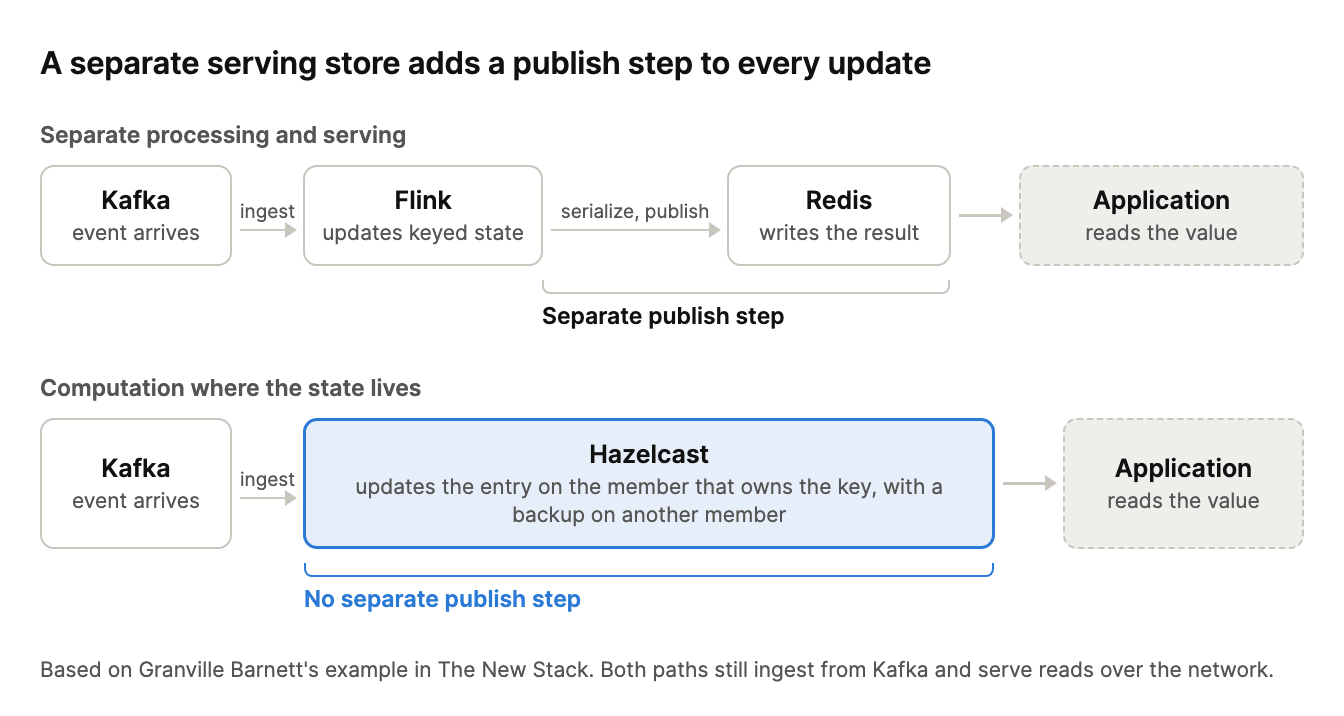
Real-time stacks often split the work: Flink processes events, and Redis serves the results to applications. That means keeping much of the same state in two places, and the extra memory is only part of the cost.
In his sponsored article for The New Stack, Granville Barnett, Architect at Hazelcast, looks at what else that split costs and when it’s worth paying.
What the second copy costs
- Data movement. Every update must be serialized, sent across the network and written into Redis before an application can read it. Granville counts four or five serialization or network steps for a single update.
- CPU. A 2025 UC Berkeley and Databricks study found CPU, more than memory, decided whether caching paid off. Serializing data and talking to a remote cache both use it.
- Another cluster. The serving layer has to be scaled and monitored on its own.
- Stale reads. Until an update lands in Redis, applications read the old value. Granville calls this export lag. A fraud check reading from Redis can score a burst of transactions against an out-of-date count.
Which copies are worth keeping
Replicas, checkpoints and durable logs earn their cost. Granville’s target is narrower. “The copies worth questioning are those maintained largely because processing and serving happen in different systems,” he writes.
For workloads where data and computation can reside together, Hazelcast takes a different approach. It partitions data by key and runs the computation on the member that owns it, so there’s no separate publish step. Backups are still written and clients still read over the network, but no second system needs a constant feed of results.
Separate systems can still make sense when a rules engine needs far more CPU than storage, when heavy compute would crowd out latency-sensitive reads, or when teams need to deploy independently.
Measure before you move
Before changing anything, check what your own pipeline spends on:
- CPU for serialization and data movement
- State held in two places
- Time from an event arriving to its result being available to applications
Granville’s full article shows how to run that comparison fairly, and how his fraud counter works when the computation runs where the data lives.